Quick Take:
• Steel conveyor rollers are the standard choice for medium-to-heavy-duty industrial and distribution applications because of their load capacity, durability, and long service life.
• Matching roller type, finish, and bearing style to your specific load and environment is the most important decision in the selection process.
• Arlington Heights facilities, from manufacturing plants to distribution centers, operate in one of the Chicago area’s active industrial corridors, making reliable conveyor components a practical priority.
The right conveyor roller keeps products moving, reduces downtime, and protects workers. For facilities handling mixed loads, frequent throughput cycles, or harsh floor conditions, a Steel Conveyor Roller by Conveyor Systems & Engineering, Inc. is typically a practical and cost-effective starting point.
Arlington Heights is a manufacturing, warehousing, and distribution hub within the Chicago area, with over 5.4 million square feet of industrial and flex space. Manufacturing ranks as the second-largest employment sector for Arlington Heights residents, with more than 4,600 people working in the field. For operations running in that environment, selecting the right conveyor component is not an abstract engineering question; it is a daily operational one.
What Makes Steel the Preferred Roller Material for Industrial Use
Conveyor rollers are extensively used throughout the world in a wide range of industrial applications, and many facilities contain tens of thousands of them. These rollers are most often made of carbon steel due to the high strength of the material.
Steel rollers give high strength, durability, and service life, making them best for demanding operations like automotive assembly, mining, and material handling, where high load capacity and wear resistance are absolute requirements.
Metal rollers are available in steel, stainless steel, and galvanized finishes. Steel provides strength, stainless steel offers resistance to corrosion, and galvanized rollers offer additional protection. Choosing between them depends on the environment:
• Standard carbon steel: best for dry, indoor, general-purpose lines
• Galvanized steel: adds a protective coating for mildly humid or outdoor-adjacent settings
• Stainless steel: preferred where sanitation, moisture, or corrosive contact is a concern
Choosing between steel and plastic depends on load weight, environment, and long-term maintenance requirements for the conveyor system.
Key Specifications to Evaluate Before Purchasing
Selecting a roller without matching it to your conveyor frame and load profile is a common and costly mistake. The following table covers the core specification decisions most Arlington Heights operations face:
|
Specification |
What to Consider |
|
Roller diameter |
Larger diameters handle heavier loads; smaller diameters suit lighter, compact items |
|
Tube wall thickness |
Thicker walls improve load rating and resist deflection under sustained weight |
|
Bearing type |
Sealed bearings reduce maintenance in dusty or high-cycle environments |
|
Finish |
Match to environment: plain steel, galvanized, or stainless based on exposure |
Selecting the proper size involves coordinating roller length with conveyor frame width and diameter with load capacity requirements. Heavy loads are accommodated with large diameters, while lightweight product applications use smaller rollers.
Warehouses gain the most from medium-to-heavy-duty steel conveyor rollers with sealed bearings. These rollers are able to withstand mixed package weights, resist wear, and run smoothly under constant usage.
Custom-sized steel conveyor rollers can also be made. Manufacturers customize length, diameter, and axle size to fit particular conveyor configurations.
Gravity vs. Powered Rollers: Choosing the Right Drive Method
The drive method shapes how a roller integrates into a broader system. Both gravity and powered options use steel rollers, but the operational context differs significantly.
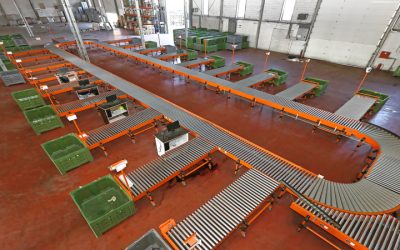
Gravity roller conveyor systems feature durable steel frames and galvanized, free-spinning steel rollers to ensure smooth movement of conveyed items without a motorized power source. These work well for loading docks, inclined runs, and staging areas where product weight does the work.
Powered roller systems use motors or belt drives to move product on flat or uphill runs. Belt-driven conveyor rollers are an MDR model that features a motorized belt that makes moving objects across a facility nearly effortless.
Facilities that run both types often use gravity sections for accumulation zones and powered sections for sortation or incline runs. Matching the drive method to each zone reduces energy use and wear on the rollers.
Safety and Compliance Considerations for Conveyor Roller Systems
Roller selection does not end at load specs. Conveyor safety is a regulated area with direct implications for how rollers are specified and maintained. ANSI B20.1, the Safety Code for Conveyors, Cableways, and Related Equipment, is the industry standard that OSHA references for various aspects of conveyor safety. Facilities should confirm that their roller systems align with this standard during both installation and routine inspection.
According to the OSHA machine guarding standards, conveyor nip points, pinch zones, and rotating components require adequate guarding to protect workers from caught-in and entanglement hazards. Roller selection affects guarding design, so specifying the correct diameter and end-cap configuration from the start reduces retrofit costs later.
Reduced vibrations from precise manufacturing translate into reduced noise, which also supports compliance with OSHA noise exposure limits in facilities running high-throughput conveyor lines.
Frequently Asked Questions
What is the difference between a standard steel roller and a stainless steel conveyor roller?
Stainless steel rollers and steel alloy are often the choice for heavy-duty applications and provide strength for tough jobs or when coming into contact with corrosive elements. A stainless steel roller conveyor system is best in manufacturing and industrial settings where hygiene or moisture exposure is a factor. Standard carbon steel suits dry, general-purpose indoor applications at a lower cost.
Can steel conveyor rollers be customized for non-standard conveyor frames?
Yes, custom-sized steel conveyor rollers can be made. Manufacturers customize length, diameter, and axle size to fit particular conveyor configurations. This customization is done to ensure compatibility, increase efficiency, and comply with industry standards.
Are steel rollers suitable for outdoor or temporary installations?
Steel conveyor rollers can work on both temporary and permanent installations; if planning an outdoor option, steel can be a great choice when the appropriate finish, such as galvanized or painted, is selected for the exposure level.
How often should steel conveyor rollers be inspected or replaced?
Inspection frequency depends on throughput volume, load weight, and environmental conditions. Sealed-bearing rollers in high-cycle distribution environments typically require periodic visual checks for flat spots, bearing noise, and shell wear. Replacing individual rollers before full failure prevents downstream damage to frames and belts.
For Arlington Heights operations that need a reliable source for both standard and custom roller solutions, Conveyor Systems & Engineering, Inc. brings deep product knowledge and a consultative approach to every project. Whether the application is a gravity staging lane or a fully powered sortation line, matching the right steel roller specification to the job is the clearest path to consistent, low-maintenance throughput.